
How Traffic Warrants Work in Maricopa County
A traffic case never begins as a countywide warrant entry. It starts with a citation filed in the court that has jurisdiction over the violation. A criminal traffic defendant who skips a required setting risks an arrest warrant plus a separate failure-to-appear allegation. Civil defendants who do not respond usually face default, extra fees, collection action, or an Arizona Motor Vehicle Division registration hold. The charge type and the court's notices set the route. Maricopa County Justice Courts handle traffic matters based on where the violation occurred, while Phoenix, Mesa, Chandler, Gilbert, Glendale, and other municipalities run their own city courts for violations within their authority. That division matters. Only the issuing judicial officer can recall or quash a warrant. A payment site, an AZDPS result, or a case-index event can point toward the right file, but none of them replaces confirmation from the issuing court.
Maricopa County Traffic Warrants: Criminal FTA and Civil Default
The official Maricopa County Justice Court traffic insert splits criminal and civil cases cleanly. Missing a criminal appearance can bring an arrest warrant, a second-degree misdemeanor FTA allegation, and suspension of operating privilege. Civil nonresponse leads elsewhere: default, a registration hold, added fees, collection, and interception of certain state payments. So treat "warrant" precisely, not as a catchall for every consequence.
| Case path | Possible court action | Best confirmation |
|---|---|---|
| Criminal traffic | FTA allegation and arrest warrant | Issuing city or Justice Court |
| Civil traffic | Default, fees, and registration hold | Issuing court case record |
| Payment plan | Default remedies if terms are missed | Court payment and docket records |
Maricopa County Traffic Warrant Checks
Use the complaint or case number if you have one. The Justice Court payment route accepts either for traffic lookup, though city systems vary. A name and date of birth can surface a statewide lead, but the citation itself usually names the court with authority over the case in Maricopa County. Check each official channel, since a new filing can lag online and local ordinance matters may never reach the statewide index.
- Read the citation and use the named Justice Court case and payment route or the relevant municipal court portal. Search with the case or complaint number.
- Use the AZDPS warrant form and Arizona Judicial Branch case index as secondary leads. Their omissions and update limits make court verification essential.
- Call the issuing clerk. For a Justice Court, use the official precinct locator because the violation location controls routing. City matters go to that city's court.
- Ask whether a records request, in-person appearance, written motion, payment, bond, or attorney filing is required, then confirm the warrant status after the court acts.
Justice Court Timing for Maricopa County Traffic Warrants
Maricopa County Justice Courts warn that a new citation may take one to two days to reach the payment system. So an immediate blank lookup may just reflect timing, not the absence of a case. The statewide court index also updates on its own schedule and does not certify active warrant status. Wait only as the court instructs, especially near an appearance deadline. Traffic jurisdiction follows where the violation occurred, not where a person lives, so the Justice Court precinct locator is the safer fallback. That official page identifies the correct precinct counter and current contact details among the county's 26 precincts. It is a geographic routing tool, which is exactly why a Maricopa County traffic warrant check must reach the proper precinct.
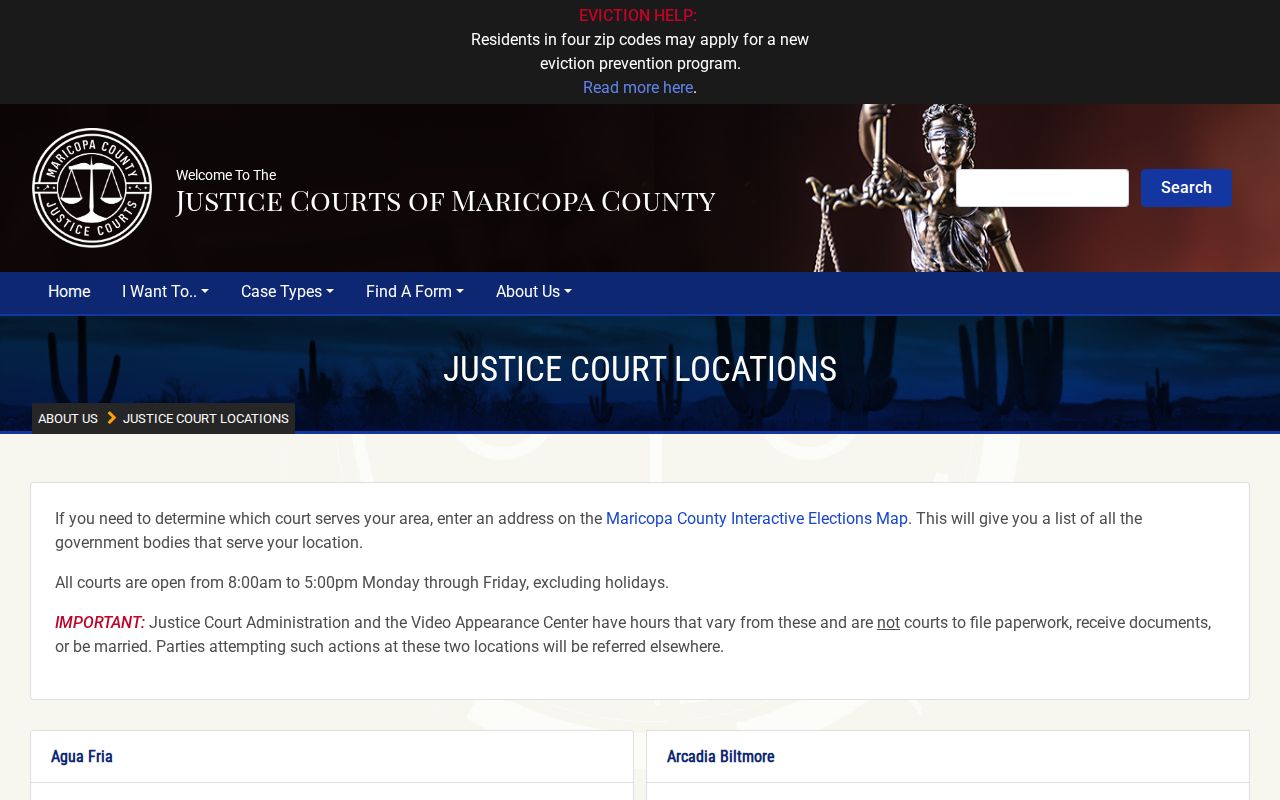
Check the live page before any visit, since Maricopa County precinct locations, phone numbers, and court assignments can change.
Traffic Warrants: What They Show
A traffic docket can show the case number, court, violation, scheduled events, disposition text, and a warrant event. The Justice Court case schema adds judge, filing date, location, case type, case status, calendar events, results, dispositions, and judgments. Read the whole event sequence rather than one label. A later recall or disposition can change what an earlier Maricopa County issuance entry means.
| Case or complaint number | The private reference used by the court, such as TR [court case number]. |
|---|---|
| Violation and case type | Identifies the filed traffic matter and whether its court treatment is criminal or civil. |
| Issuing court | Names the municipal court or Justice Court precinct that controls the record. |
| Events and disposition | May show an FTA, warrant issuance, hearing result, payment event, or later recall. |
| Case status | A docket label that still requires confirmation when the question is whether a warrant remains enforceable. |
Phoenix and Mesa Offer Different Warrant Relief
Phoenix Municipal Court handles warrant relief in writing. A request can include the defendant's name, case or complaint number, date of birth, contact information, the reason for the missed date or payment, the requested action, supporting copies, and a proposed affordable payment contract. The court says to allow ten days. Outcomes range from cancellation with a contract to a new date or a motion hearing. Mesa Municipal Court takes a different path in Maricopa County. Its warrant page tells a person with an outstanding warrant to take a customer-service number and check in at 250 E 1st Avenue. Walk-in hours run Monday through Thursday, 8 to 11 a.m. and 1 to 5 p.m. Relief depends on the judge and may involve quashing the warrant, addressing jail or counseling terms, or lifting an MVD suspension. The official Mesa warrant page documents that walk-in route without exposing anyone's Maricopa County traffic warrant record.
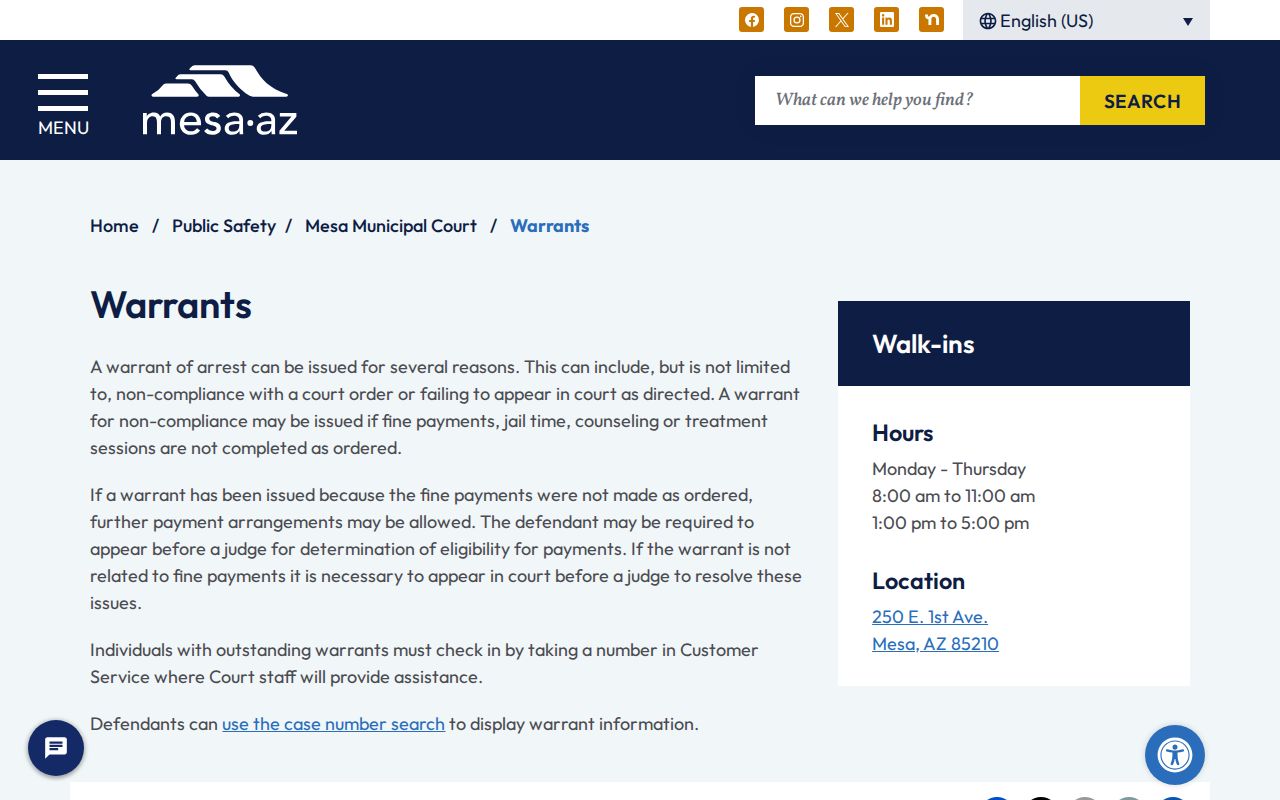
These city processes are not interchangeable. Follow the court printed on the citation.
Clearing a Maricopa County Traffic Warrant
Start with a status check and instructions from the issuing court. Payment may resolve some eligible civil matters, but criminal traffic charges generally require court interaction. A payment plan alone does not prove a warrant was recalled. Phoenix, Mesa, Chandler, Gilbert, and Glendale each publish distinct motion, walk-in, payment, or appearance routes, so rely on the specific city court rather than importing another city's terms into your Maricopa County case.
- Confirm the traffic case, warrant status, balance, and required court action with the issuing clerk.
- Follow the authorized option: file a motion, appear, make an eligible payment, arrange a court-approved plan, or address bond as directed.
- Keep the receipt, filed motion, minute entry, disposition, and any MVD abstract or release document.
- Recheck with the same court after processing and separately confirm whether any license or registration consequence was released.
Warning: A receipt or payment plan does not prove recall. Obtain the issuing court's recorded disposition before treating a traffic warrant as cleared.
Point & Pay Is a Payment Tool, Not Clearance
In 2025 the Maricopa County Justice Courts rolled out an improved Point & Pay portal. Optional accounts bring automatic payments, tracking, notifications, and history. Traffic lookup takes a case or complaint number. A payment-plan lookup can use a driver-license number instead. Among the accepted methods, the court lists card payments, Apple Pay, and Google Pay. One warning stands out. Never click the final Pay button twice. Bigger point: the portal cannot decide whether a judge must recall a warrant. Not all charges qualify for online payment. Criminal traffic generally requires direct interaction with the court. So confirm the case and the court's instructions through the official route, then pay. Maricopa County also posts an official payment page that explains the portal and its timing notice. That page holds no personal traffic warrant data.
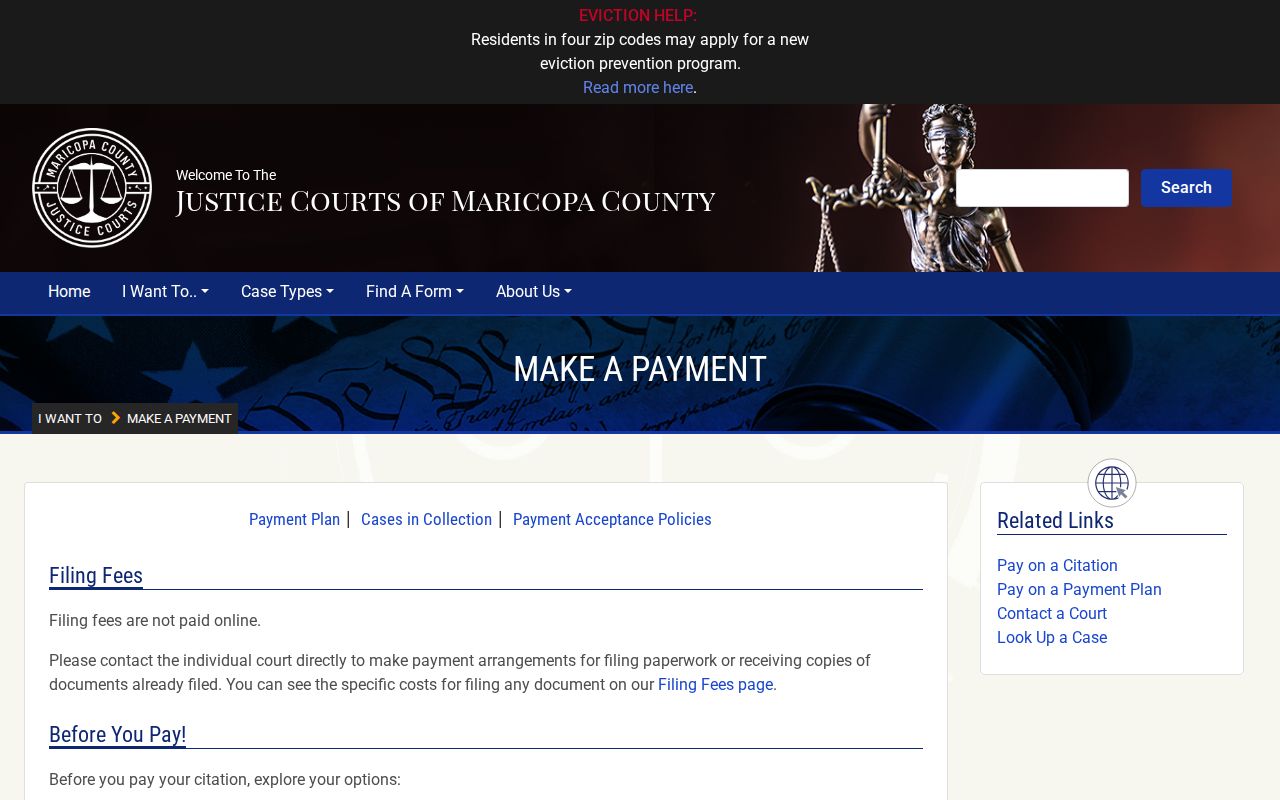
Keep your Maricopa County payment proof, then ask the court whether a separate appearance, motion, or warrant recall is still needed.
Traffic Warrant Procedures Change by Maricopa County City
Traffic warrant procedure changes by Maricopa County city. Chandler Municipal Court treats a criminal failure to appear as possible warrant ground. Its published choices are a written motion to continue or a walk-in appearance. Walk-in hours are 8:30 to 11:30 a.m. and 1:30 to 4:30 p.m., Monday through Friday except holidays. Civil is a different track. The court describes a default amount plus $50 and possible driving-privilege suspension. An abstract may be required to lift an MVD suspension. A receipt is not an MVD release. Treat the two as separate documents. Gilbert works from an official sanction form. It asks for a complaint number, violation date, sanction choice, payment information, and a signature. Before the court date, mail, fax, or a 24-hour drop box all work. After the date, the form says appear immediately. A payment plan needs an appearance and carries a $20 time-payment fee. The published missed-date contact is 480-635-7800. That Gilbert instruction binds Gilbert's court alone, not another Maricopa County city or a Justice Court precinct.
Glendale's bond card describes online, mail, and in-person payment routes, plus separate instructions for civil traffic ticket numbers. Skip those steps and this Maricopa County court warns that noncompliance can bring an arrest warrant, default, suspension, and collection fees. The court sits at 5711 W Glendale Avenue. Its published main number is 623-930-2400. Payment questions go to 623-930-2427. A quick call can prevent a wasted trip over an old form or a wrong assumption about appearing. Mesa, another Maricopa County city, adds its own pattern through FARE and TTEAP. Default on a payment plan there may bring a $70 default fee, a warrant, other fees, a $49 delinquency fee, interception of refunds, and a registration hold. That list is what can happen. It is not what every default causes. The Mesa court record and the clerk's current instructions control. Phoenix may route full payment through several channels too, yet a written motion or hearing can still be the relevant path in Maricopa County.
Whatever the Maricopa County court, keep a private checklist. Record the court name, case or complaint number, criminal or civil classification, latest event, required court action, payment confirmation, and any MVD document. Never post those identifiers. Once the stated task is done, ask the clerk three things: whether the warrant was recalled, when the docket will reflect the ruling, and whether a separate hold release will be transmitted. That last confirmation is what turns a payment or appearance into reliable knowledge of court status. Arizona's case index does include a vehicle-registration-hold option. Use that checkbox only for its stated purpose. It does not search every Maricopa County traffic warrant. It cannot tell whether a city judge recalled one. A change in driving or registration status likewise will not explain every court event, so track the court case and the MVD consequence as two linked but independently verified lines. A name search in Maricopa County may return several people. Do not guess from a partial match. Use the date of birth privately where the official form accepts it, then confirm the case number and the issuing court. AZDPS even warns that name variations can repeat a warrant number. If the matter carries arrest risk, probation, a serious criminal traffic charge, or uncertainty about surrender, consult an attorney before appearing. And do not drive to any Maricopa County court when the privilege to drive may be suspended. Arrange safe transportation. Follow only instructions from an official Maricopa County court page or number.
How Traffic Warrants Trigger License Holds
A warrant is not a suspension. A failure to appear is not a registration hold. These are separate mechanisms even when one Maricopa County citation starts them all. Arizona's public case index carries a vehicle-registration-hold checkbox. But that box is no warrant search. Resolving the balance may not remove every consequence either, not until the issuing court sends or records the proper release.
| Mechanism | What Triggers It | What It Does |
|---|---|---|
| Traffic arrest warrant | Criminal traffic nonappearance when ordered to attend | Authorizes custody until the court addresses the matter |
| Failure to appear | Missing a required setting | Creates a docket event and can support a separate allegation or warrant |
| License suspension | A qualifying criminal traffic FTA or other reported event | Affects operating privilege until the proper release is processed |
| Registration hold | Civil default or nonresponse reported through the court process | Can block vehicle registration action until released |
Do not drive if the license may be suspended. Call the Maricopa County court first, arrange safe transportation, and ask whether counsel should coordinate the appearance.