
Maricopa County Warrant Checks
A Maricopa County warrant check works best as a chain of official steps. The Arizona Department of Public Safety warrant search is the first public lead. It asks for a first name, last name, and date of birth. Read its warning closely. The data is not real-time, current, active, or complete, and the form returns no more than five results. Any match must then be confirmed by the court named in the result.
- Gather the exact legal name and date of birth for your own record, or for a relative you are helping.
- Run the AZDPS form and privately note the court, case reference, and official contact path.
- Check the Arizona Judicial Branch case index by name or case number.
- Identify whether the matter belongs to Superior Court, a geographic Justice Court precinct, or a municipal court.
- Call that issuing court and ask whether the warrant is active and what action is required.
- Use the court's motion, walk-in, bond, attorney, or surrender process, then keep proof and recheck the status.
The Maricopa County Sheriff's Office also links to "Look up a Warrant," public-record requests, and a GJ-15 warrant-confirmation and self-surrender form. Call MCSO directly for the current fields on those tools before you rely on them. A records request can return an existing public record, but it is not a live status certificate.
AZDPS Fields for Maricopa County Warrants
The statewide form asks for only a few items. Each one helps narrow a match. Even all three together cannot prove identity or current Maricopa County warrant status.
| Field | Required | How to use it |
|---|---|---|
| First Name | Yes | Use the legal first name reported to the court. |
| Last Name | Yes | Check spelling and known name variations. |
| Date of Birth | Yes | Use it privately to reduce same-name matches. |
| Apply | Action | Read the result warning before drawing a conclusion. |
The official AZDPS search page appears above in an empty-form state, without any person's result data.
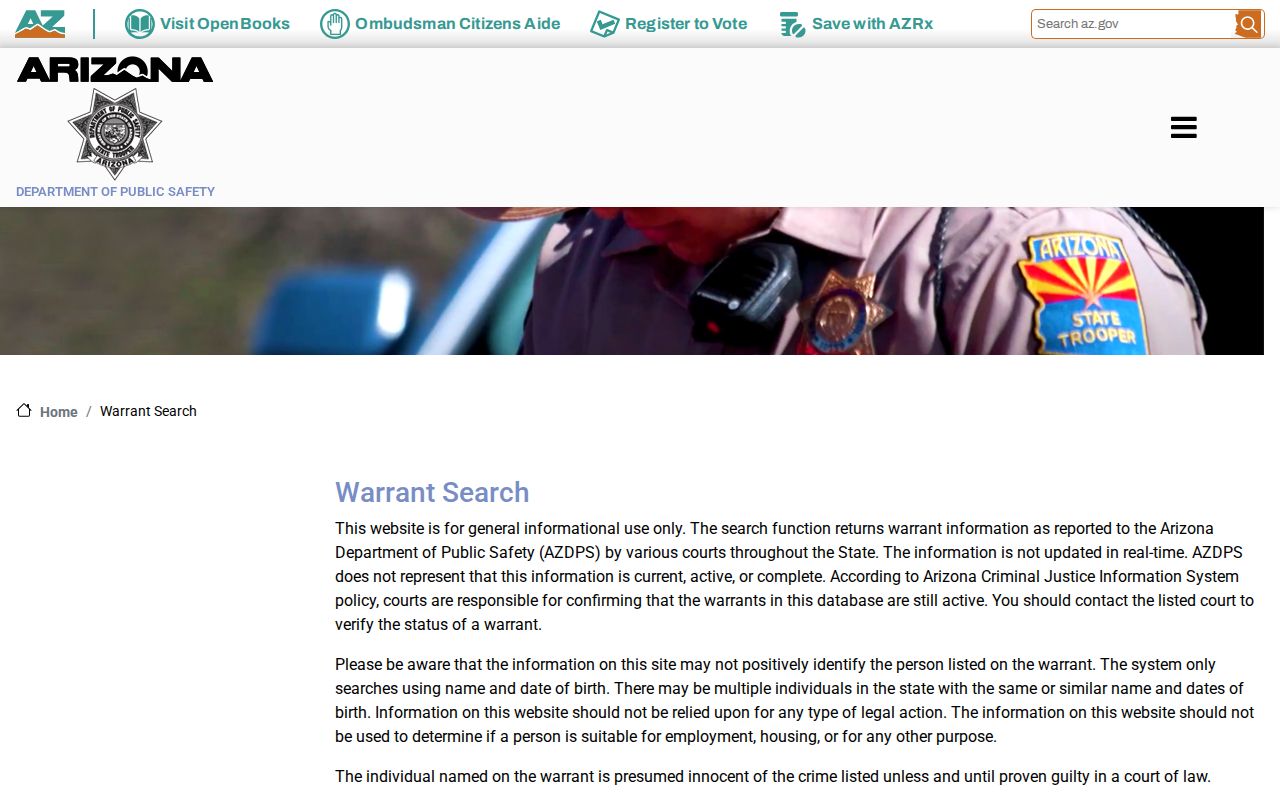
The screen shows why a court call belongs after every search. It is a lead to an issuing authority for a possible Maricopa County warrant, not an order confirming that one exists or has been cleared.
Warrants in Maricopa County: The Main Types
Arizona uses several warrant labels. The event behind the order and the issuing court matter more than the label. A bench warrant is still authority to take a person into custody. A search warrant, by contrast, concerns a place, item, or data rather than a public personal-status lookup in Maricopa County.
| Warrant Type | How It Arises | Who Issues It |
|---|---|---|
| Arrest warrant | A sworn probable-cause showing supports custody. | A judicial officer with jurisdiction. |
| Bench warrant | A missed hearing, probation issue, or failure to follow a court order. | Superior, Justice, or Municipal Court. |
| Search warrant | Probable cause supports a specified search or seizure. | An authorized magistrate. |
| Traffic FTA warrant | A person misses a required date in a criminal traffic matter. | The city or Justice Court handling the citation. |
A summons and a warrant are not the same thing. A summons directs a person to appear without first authorizing custody. Fail to appear, and a Maricopa County court may issue a warrant. Civil traffic nonresponse can instead cause default, added fees, or a vehicle-registration hold, so ask the issuing court which result applies.
Why No Maricopa County Warrant Result Is Not Clearance
An empty Maricopa County warrant result means only that one source found no match under its current rules. The statewide court index says it covers 177 of 184 courts and refreshes weekly. It excludes sealed cases, local ordinance charges, protected matters, and several juvenile categories. AZDPS separately warns that its warrant data is not real-time or complete. A new warrant may not have reached the public interface yet. A recalled warrant may still appear while systems update. City cases create another gap. Phoenix, Mesa, Chandler, Gilbert, and Glendale each have their own city court route, and a local ordinance event may be missing from the statewide case index while it stays in the municipal court file. Justice Court cases must also be routed to the right precinct. The safest reading of "no result" is "call the likely court for confirmation," never "there is no warrant."
Note: Never publish, confront anyone about, or act on a possible match from a public search result.
Maricopa County Warrant Records: What They Show
Public Maricopa County warrant records vary by system. A Justice Court docket can show an event or disposition instead of a simple active-warrant badge. The clerk file may include documents the public index does not display. Sealed, closed, confidential, juvenile, victim, and witness information can be removed or withheld.
| Warrant number | COURT-CASE-REFERENCE links the order to a court file when one is public. |
|---|---|
| Subject | Name and limited identity details used for a private match. |
| Charge or event | The alleged offense, missed setting, probation issue, or other basis. |
| Issuing court | The Superior, Justice, Municipal, state, or federal court that controls the order. |
| Bond | An amount, release term, or no-bond notation when public. |
| Status | Issued, active, served, recalled, quashed, cancelled, or another court entry. |
The Arizona case index offers name and case-number modes, a court selector, and stated exclusions.
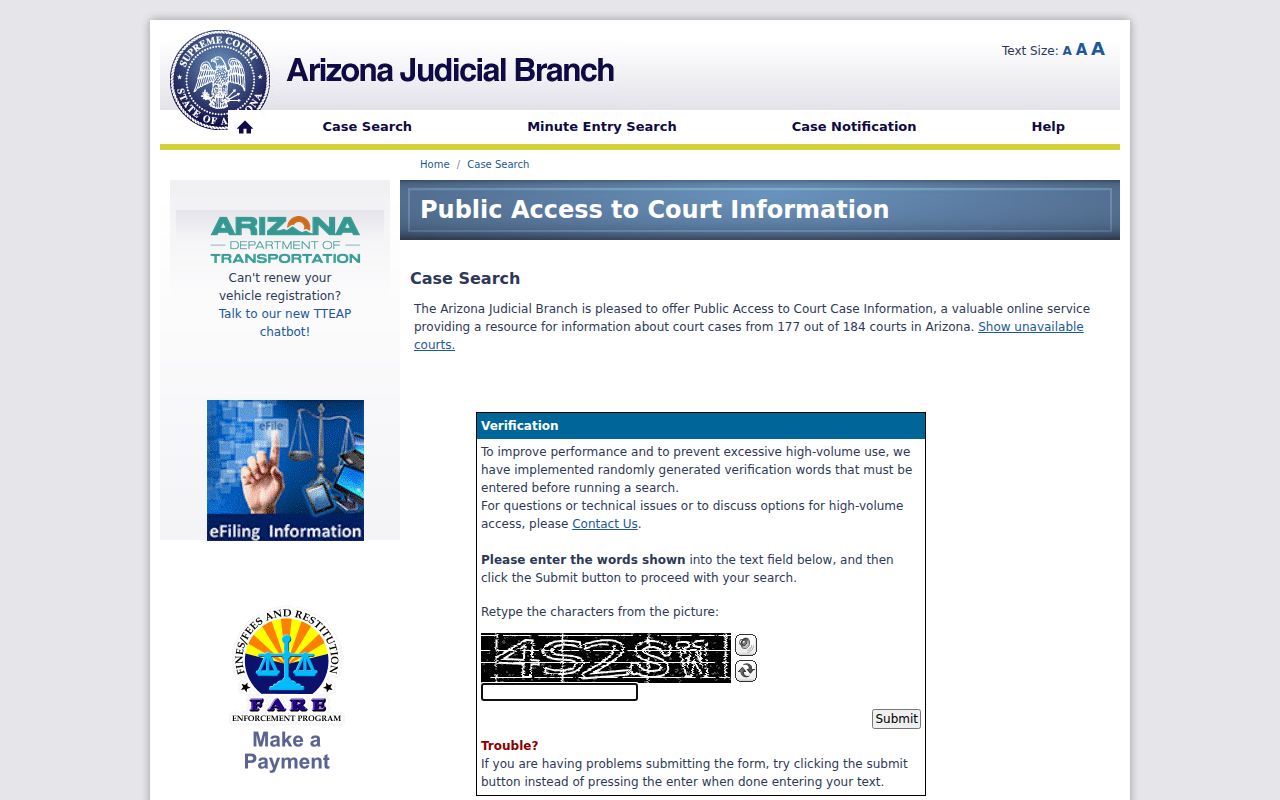
Use those fields to find the court of record. Then ask that Maricopa County court whether its public entry reflects the current warrant state.
Maricopa County Court Geography
Maricopa County warrant records are split across more than one court level. Superior Court handles felony and trial-level criminal matters. The county has 26 Justice Court precincts, and the precinct tied to where a violation occurred may control a traffic or lower-level criminal case. Separate municipal courts handle their cities' misdemeanor, traffic, and code matters. That split is why one countywide name search cannot answer every warrant question.
For Justice Court, use the official precinct locator. Do not pick a precinct just because it is nearer. For Superior Court, the Criminal Department Information Desk is the official fallback when a public case search cannot locate the matter.
Maricopa County Warrants: Who Issues, Who Serves
Courts issue warrants. Law enforcement serves or executes them. In Maricopa County, a Superior Court judge, Justice of the Peace, or city magistrate can issue an order within that court's power. MCSO, constables, city police, and other authorized officers may carry it out. A prosecutor can ask the court to act but cannot cancel a court warrant alone.
Maricopa County Sheriff's Office
Official warrant lookup, record-request, service, custody, and self-surrender routing.
602-876-1000
Superior Court Criminal Department
Confirms Superior Court matters and routes the person to the issuing division.
Superior Court warrant information
602-506-8575
The warrant flow is: court event → warrant issued → service or court action → court records the result. A sheriff list or state form can point to that flow, but the issuing court decides whether the warrant has been quashed, recalled, or resolved.
MCSO Warrant Routes
The Maricopa County Sheriff's Office offers three routes from its home page: Look up a Warrant, Request a Report, and Send a Tip. The MCSO warrant link is the official entry point for a warrant search, so start there and skip any copycat site. If that page stalls or does not answer your question, AZDPS and the issuing court are the next stops. The MCSO home page itself lists the links but no person-specific results.
Requesting a record is a separate track from the live warrant lookup. Through the Maricopa County public-records portal, you ask for a specific existing record and pick the likely custodian. The MCSO document list also names GJ-15 for warrant confirmation and self-surrender; take its terms only from the current official form. The MCSO lookup target itself opens as an empty or loading state.
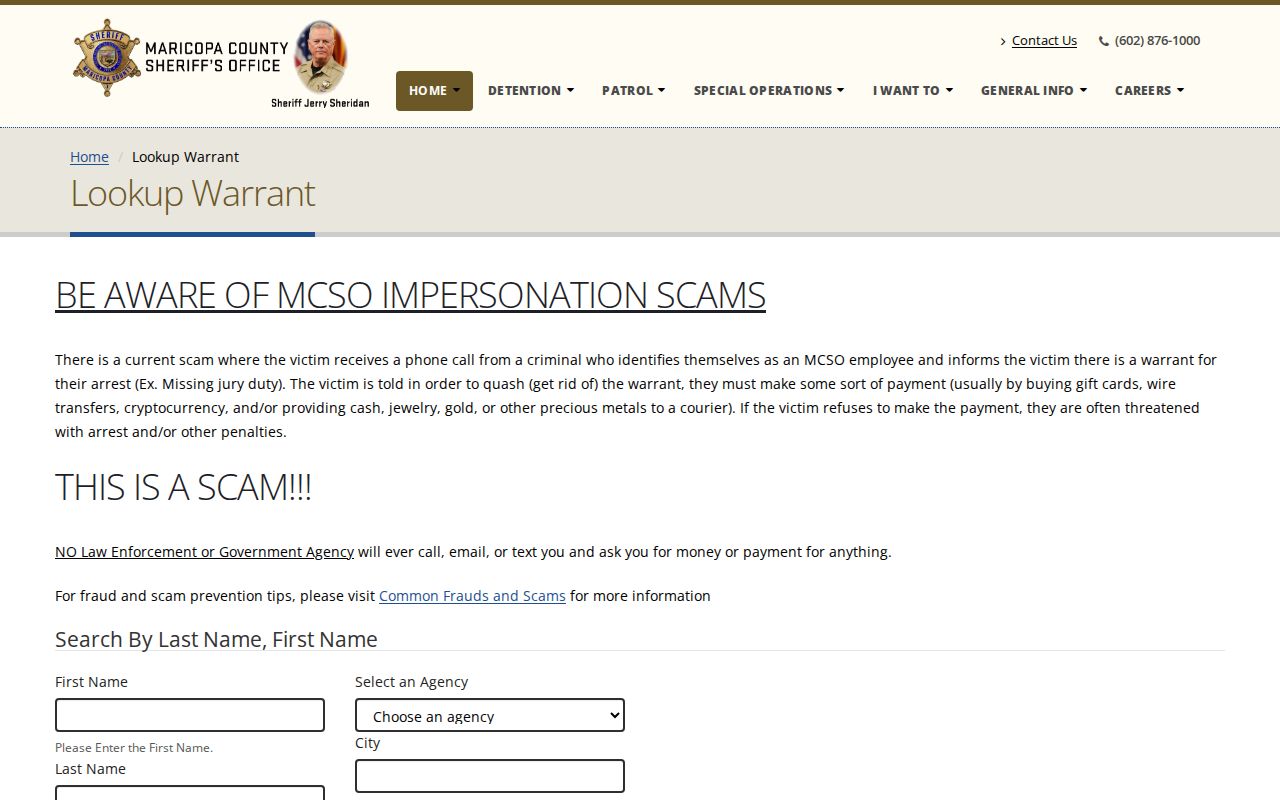
The Maricopa County lookup screen displays no field names and no update schedule. Go by the live page, not assumptions about either.
Handling a Maricopa County Warrant
Start with the issuing court, and ask what it accepts: a motion, an attorney appearance, a walk-in, bond, full payment, or self-surrender. Superior Court states that only the issuing court can resolve, quash, or cancel its warrant. A Justice Court matter belongs to its geographic precinct. Each Maricopa County city court sets its own method for a missed date or unpaid obligation.
Act with care. For a felony, probation violation, extradition risk, uncertain match, or no-bond issue, consult an attorney before appearing or surrendering.
Paying a fine does not always end the warrant. Maricopa County courts caution that payment alone may settle the amount while leaving an FTA event, a suspension, a required appearance, or the warrant itself in place. Ask plainly what action clears the warrant, and how the court will record it. Keep the signed order, minute entry, receipt, bond or release paper, and clerk confirmation. Then recheck after the stated processing time. If the court directs a surrender, confirm the facility and paperwork first. The Intake, Transfer and Release facility runs as a 24-hour custody and release site, not a universal walk-in warrant counter. The order and the issuing court decide whether ITR is the right place for a Maricopa County defendant.
Maricopa County Bond Scam Signs
Maricopa Superior Court issued a 2026 warning after scammers targeted defendants' family members. The court never requests bond by phone call, text, email, or social-media message. Bond cannot be paid through Zelle, Venmo, Cash App, a wire transfer, or a caller's QR code. An urgent demand plus a caller-supplied payment link is a warning sign, even when the caller recites public case details. Hang up and verify with the Maricopa County court itself.
Verify independently. Use the court's published warning and call the Criminal Information Desk at 602-506-8575 or MCSO SIMS at 602-876-0322.
A real bond comes only through the court process. Ask whether bond exists, where it may be posted, which payment types are accepted, how long release processing can take, and what the next court date will be. Never treat a caller's quoted sum as a verified Maricopa County warrant bond.
Warrant Record Access Under Arizona Law
Arizona law favors access to existing public records, but the access has limits. The right route depends on the custodian: a court, a county department, the sheriff, or a city police agency. A docket index is not the clerk's complete file. And a public-records request does not force a Maricopa County agency to create a new real-time warrant certification.
Key access rules. A.R.S. §39-121 covers inspection and copying; Arizona Supreme Court Rule 123 governs court records; A.R.S. §13-3918 sets search-warrant return timing; and A.R.S. §8-208 limits juvenile access.
Closed, sealed, confidential, juvenile, victim, witness, mental-health, and protected identity data may be withheld or redacted. Pre-charge arrest-warrant records can also have limited early availability. Those limits explain some blank searches, but a blank result does not show that no warrant exists in Maricopa County.
Maricopa County Warrant Terms
A short docket label can hide a big difference in what has actually happened. In Maricopa County, read the entry with the court, the date, and the next event rather than trusting one word.
- FTA
- Failure to appear at a required court setting.
- Active or outstanding
- The issuing court currently treats the warrant as enforceable.
- Quashed or recalled
- The court has withdrawn the warrant, often while setting a new duty or date.
- Served or executed
- The authorized arrest or search action took place.
- Bond forfeiture
- Loss of a bond after a required appearance is missed.
- Pre-charge warrant
- An arrest warrant issued before a public charging record, with special early access rules.
Arizona sources do not lean on a special capias label as the main Maricopa County term for these routes. “Bench warrant,” “arrest warrant,” and “failure to appear” are the labels readers will actually meet. The wording matters less than the status. Only the issuing court can confirm it.
Maricopa County Records in Person
The right building depends on the file you need. Superior Court's Central Court Building sits at 201 W Jefferson Street in Phoenix and lists weekday public hours from 8 a.m. to 5 p.m. The Clerk of Superior Court also lists records centers at 601 W Jackson in Phoenix, 14264 W Tierra Buena Lane in Surprise, 222 E Javelina Avenue in Mesa, and 18380 N 40th Street in Phoenix. Public computers there allow free inspection of open records. Before you travel, nail down the court, division or precinct, case number, and the record you want. Ask whether identification, a filed motion, payment, an appointment, or an attorney is required. A Maricopa County records counter is not a warrant-clearing desk, and the issuing court may send you elsewhere for bond or surrender. The official ITR location page spells out that separate custody and release role.
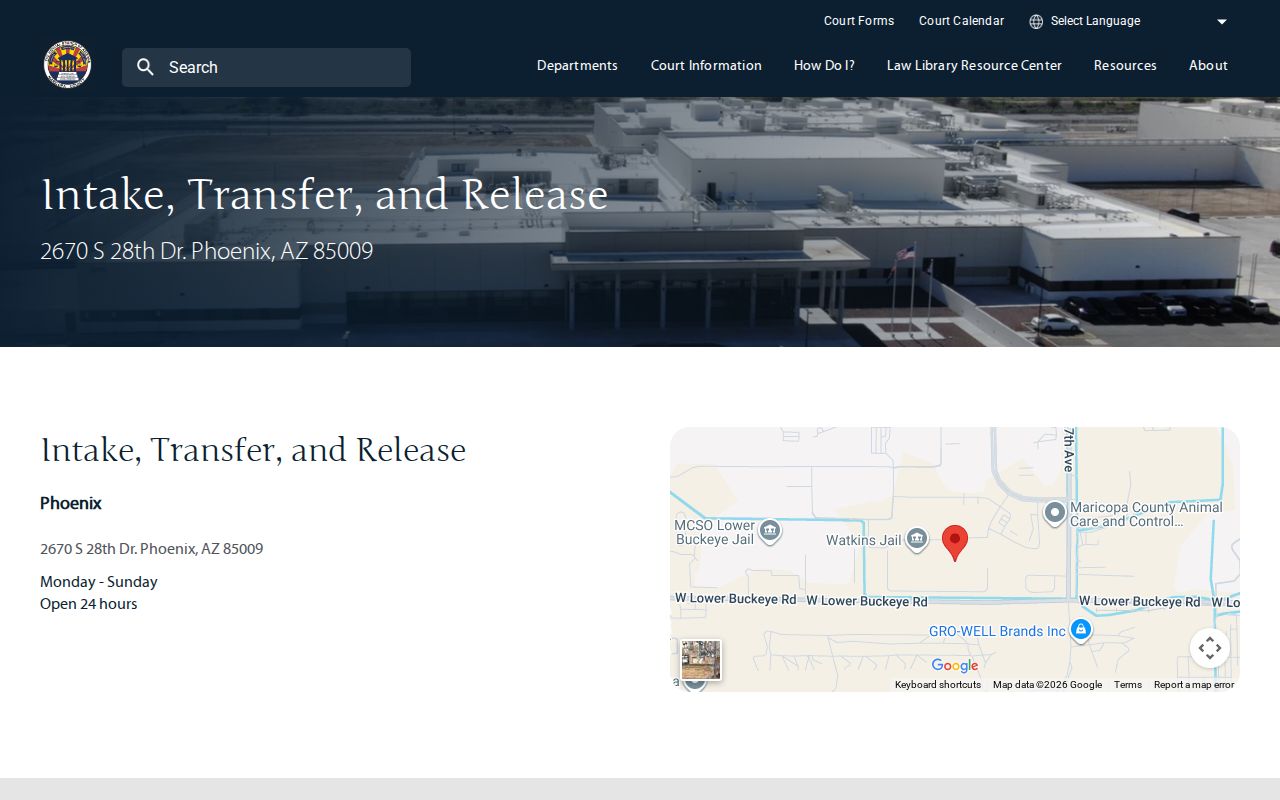
ITR is open around the clock with free parking. Still, go there only when the Maricopa County court's current instruction makes it the right place.
City Warrant Records in Maricopa County
The five largest Maricopa County cities each run their own municipal court and police routes. Those local systems handle city misdemeanors, traffic matters, and ordinance cases, while felonies route to Superior Court. When a citation, a missed city-court date, or a local case is the likely source, start with the city court.
A city search still ends at the court. A police records office may hand over an existing report, but it cannot replace the municipal court's answer on an active warrant or recall in Maricopa County.