
How Arrest Warrants Work in Maricopa County
An arrest warrant gives law enforcement the power to take a named person into custody. Arizona guidance lays out the mechanics. A judicial officer reviews a sworn statement that establishes reasonable belief or probable cause, and A.R.S. §13-3897 supplies the felony affidavit and probable-cause framework while calling for prompt presentation before a magistrate after an arrest. In Maricopa County, Superior, Justice, and Municipal Court judicial officers can each issue warrants within their own authority. Once issued, an order stays active until an arrest or court action resolves it. A prosecutor can ask for that action but cannot cancel the warrant alone. Search results may point to a source, but only the issuing court can confirm whether a Maricopa County warrant still carries force.
The Sworn Foundation for a Maricopa Warrant
Probable cause is what separates a new arrest warrant from a typical bench warrant. Sworn facts go to a judicial officer. That officer decides whether legal grounds support custody. The public case record may later show a filing, an event, a charge, or a warrant reference, though the affidavit itself stays out of view. A search hit is only a lead, never a finding of guilt. If a Maricopa County check turns up a possible warrant, capture the issuing court and case reference alone. Then use official court contact and legal advice to plan the next step.
Arrest Warrants: What They Contain
Fields vary by source and access status. Treat public metadata in Maricopa County as routing information only, and do not reproduce a private person's details.
| Warrant reference | An official identifier, illustrated only as WARRANT-REFERENCE. |
|---|---|
| Related case | The court case number used to find events and filings. |
| Issuing authority | The judge, magistrate, or court that controls the order. |
| Issue date | The date of judicial issuance, subject to later events. |
| Charge information | The public allegation and classification, if disclosed. |
| Bond or release | An amount, no-bond notation, or condition requiring current confirmation. |
| Status | Active, served, recalled, quashed, or cancelled as the court records it. |
Victim, witness, investigative, juvenile, sealed, and identifying information may be withheld or redacted.
Pre-Charge Maricopa Warrants May Stay Hidden
Arizona's 2025 emergency rule changes added Rule 2.7 and shifted when pre-charge arrest-warrant records become public. The official summary described access after proof of service is filed, the warrant expires, or the order is quashed. Verify current rule text, since the amendments faced later consideration. A pre-charge Maricopa County warrant may simply stay hidden.
Access limit: A missing pre-charge record is not evidence that no arrest warrant exists.
Sealed and confidential material also stays closed under Rule 123. Police records may redact arrest or investigative details even when a court docket has public entries. Ask the correct custodian for the correct existing record rather than assuming one portal holds the full Maricopa County file.
How Warrants Get Served in Maricopa County
Serving a warrant means law enforcement takes the named person into custody under the court's authority. MCSO's official site links a warrant lookup and runs county custody systems. City police and other agencies act within their own jurisdictions. Service can lead to an initial appearance, bond and release decisions, or a transfer depending on the case. Maricopa County's Initial Appearance Unit runs around the clock with repeated sessions, but that workload says nothing about how many warrants are active. ITR processes court-directed self-surrenders and jail releases. Nobody should walk into a jail on a web result alone. First confirm the court, the warrant, the facility, the paperwork, and the attorney plan.
Arrest Warrants, Summonses, and Bench Warrants
The three routes should not be collapsed into one status.
| Process | Basis | Effect |
|---|---|---|
| Arrest warrant | Sworn probable-cause showing | Authorizes custody |
| Summons | Court order to appear without initial custody | Requires appearance; later failure may support a warrant |
| Bench warrant | Missed hearing or court-order noncompliance | Creates arrest authority from the pending case |
A search warrant is different again. It authorizes a specified search or seizure under A.R.S. §§13-3911 through 13-3925, not a personal arrest-status record for Maricopa County. Tracking-device and cell-site-simulator warrants can carry their own disclosure timing.
Verify a Maricopa Arrest Warrant With the Court
Begin with the AZDPS Warrant Search, entering first name, last name, and date of birth. It returns no more than five matches. The state warns the data may be incomplete. Turn next to the Arizona Public Access Case Lookup by name or case number, then MCSO's official warrant route. If a Maricopa County city or Justice Court appears in the results, contact that court directly.
- Record the court and case reference privately.
- Call through the court's official page.
- Ask whether the warrant is active and whether bond is set.
- Ask whether counsel, a motion, walk-in, or surrender is required.
- Keep the court order and recheck after processing.
Superior Court's Criminal Department Information Desk is 602-506-8575.
Maricopa Court Files and Police Records Differ
The Superior Court warrant page explains the issuing-court route and the arrest and bench labels Maricopa County uses.
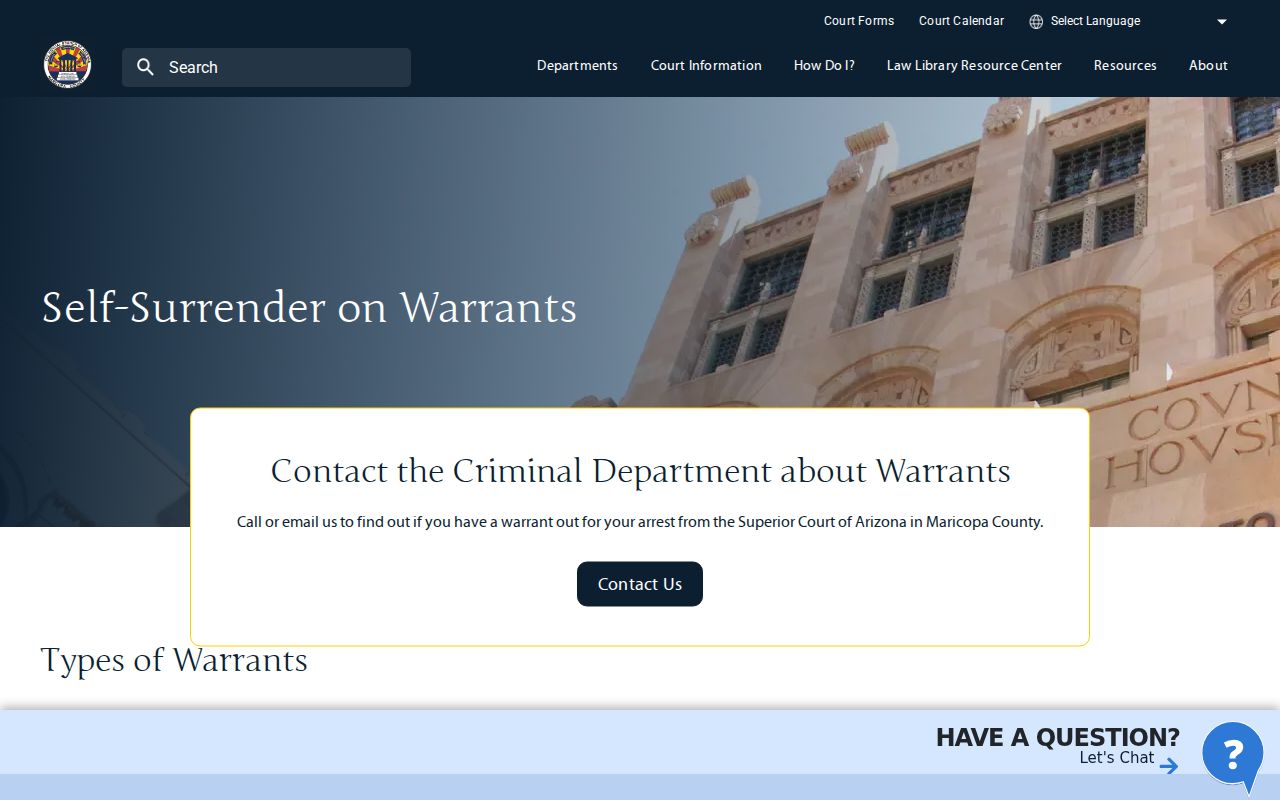
The court file holds judicial events, orders, and public filings. A police record sits with a separate custodian. It may be redacted for investigative, victim, witness, or privacy reasons. The Clerk provides public case inspection and copies subject to Rule 123, while a police records unit answers only for its own existing reports. A public-record request is not live warrant certification. Ask for a specific record, name the likely custodian, and expect redaction or delay. For current enforceability of any Maricopa County warrant, the issuing court remains the source.
Handling an Arrest Warrant in Your Name
Do not ignore a credible match. Do not assume any jail accepts an unscheduled surrender for every case. A lawyer in Maricopa County may confirm the facts, file a motion, arrange an appearance, discuss bond, or coordinate a court-directed surrender. Ask the issuing court whether a judge must review release conditions and where an authorized bond may be posted.
Important: Get legal advice before appearing when the matter involves felony allegations, probation, extradition, uncertain identity, no bond, or complex release terms.
If the court directs ITR, its official location is 2670 S 28th Drive in Phoenix, open 24 hours. That schedule covers custody operations, not every public Maricopa County court service. Bring the required court paperwork and follow the exact instruction given.
Confirm Maricopa Warrant Resolution and Bond
Bond is money pledged to secure an appearance, and it does not by itself quash a Maricopa County warrant. Superior Court sets bond at the initial appearance. Release processing can take up to 24 hours after proper posting, so plan for that wait. Before paying anything, ask the court whether bond exists, where it must be posted, which payment types are accepted, and when the next appearance falls. Money alone can leave the warrant or a required hearing unresolved. The official Superior Court bond page spells out in-person posting rules, the scam warning, and the possible release-processing time.
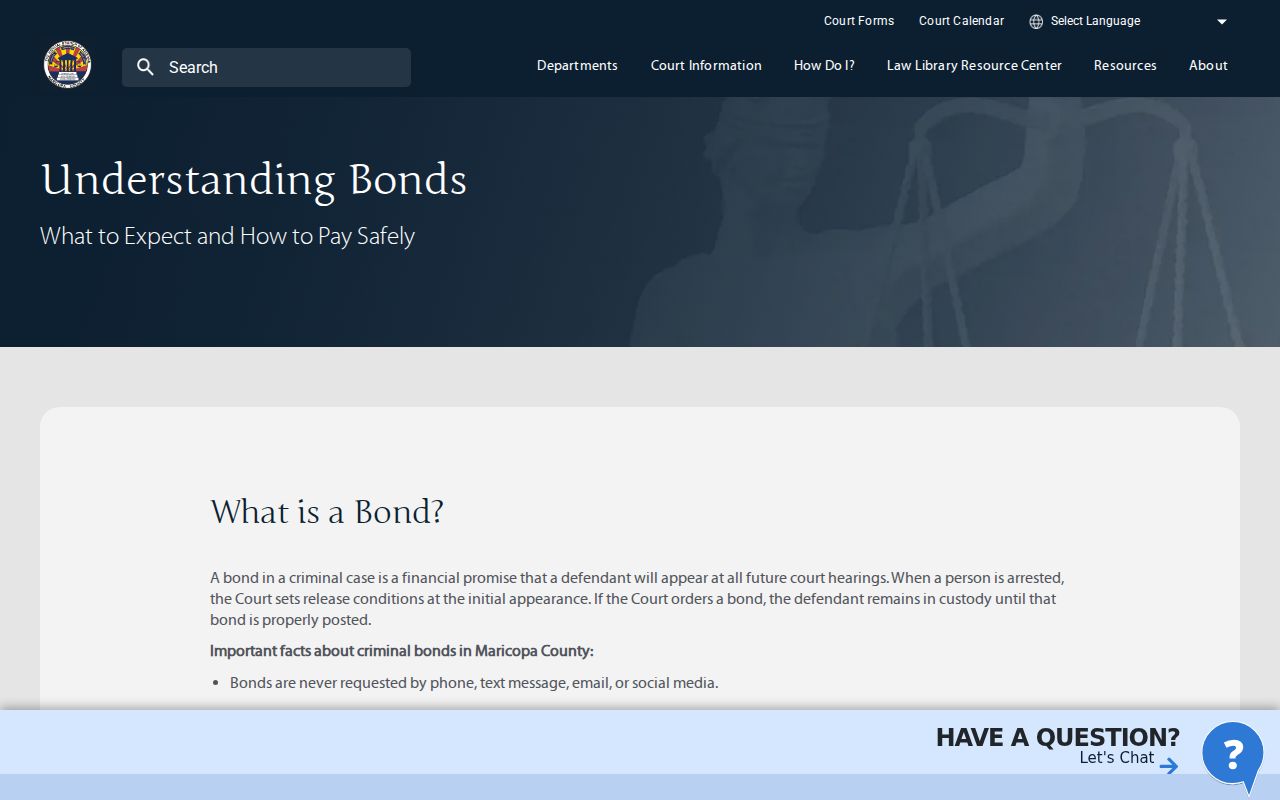
Verify the payment method with the issuing court before you pay anything, because the current order controls both the amount and the channel. Maricopa County warns that no court asks for bond by phone, text, email, social media, payment apps, wire, gift cards, cryptocurrency, or QR codes. Hang up on that pitch. Call 602-506-8575 yourself, or reach MCSO SIMS at 602-876-0322. Keep the signed order, the minute entry, any receipt, the bond paper, and your release conditions in one place. Then recheck with the court. The Maricopa County warrant records overview lays out the fuller official-check sequence for a Maricopa County warrant search. For copies of court records, the Clerk runs public inspection centers and eAccess for unrestricted documents in covered cases. The public docket can show filings, events, and case outcomes. Minute entries cover only a narrower set of criminal matters. Copies, certification, and research each carry separate charges. None of these products confirm live warrant status. Sealed or confidential material stays off limits. Handle a near-name match with care. Do not share it or contact that person. Compare the date of birth privately, use the exact case number, and ask the court to verify the party and the issuing authority. When a public search comes back empty, remember that AZDPS data can lag. A city ordinance matter may sit outside the statewide index. Pre-charge records may not be public yet. So a clear answer turns on the right court, not on how many places you search.
After an arrest or a surrender, ask for the next court date, the bond and release conditions, and the document showing what happened to the warrant. Prompt judicial review after arrest is built into the Arizona framework, though timing and relief vary with the case. A lawyer can read the order and stop you from over-reading a short docket label. If the warrant came from another state, call that issuing jurisdiction and ask counsel about extradition. A Maricopa County court cannot cancel another court's warrant. A federal matter belongs with the District of Arizona and the PACER route, not a county case screen in Maricopa County. Keep the jurisdiction straight. It saves you calls to an office with no power to grant relief.