
How Municipal Court Warrants Work
Arizona municipal courts work inside their own city limits. Their dockets cover city misdemeanors, traffic charges, code violations, and failures to appear or comply. Miss a date there and the judge can issue a bench warrant. That order is a court order. It sits on the docket, with its status controlled by the issuing judge and the docket event, not by some separate public database entry. Maricopa County Superior Court hears appeals from 23 municipal courts and 26 Justice Courts. Those are separate systems. Nobody runs one unified warrant list. A city warrant can appear in a local portal and still be missing from another public search, so confirm it with the Maricopa County court named on the case.
Maricopa County City Court Warrants Are Not Superior Court Warrants
Superior Court handles felonies and general trial-level matters. Municipal courts handle what falls inside city authority. The split matters when a warrant shows up. The Maricopa County Sheriff's Office may serve a city warrant or hold information on it. It cannot quash an order a municipal judge signed. A police records desk has the same limit: it can hand over existing public records subject to law, but only the issuing court can confirm a warrant's current status. A statewide result may name Maricopa County and still point to the wrong division. Use the Arizona case index to find the right court and case type. Superior Court questions go to its Criminal Information Desk at 602-506-8575. City matters go to the municipal clerk. Justice Court matters go to the precinct where the violation occurred.
Municipal Courts Across Maricopa County
Phoenix, Mesa, Chandler, Gilbert, and Glendale each run their own municipal court route. The table maps one path per city. Maricopa County has other city courts too. Traffic matters from unincorporated areas or precincts often belong in a Justice Court instead, and the official court directory settles uncertain jurisdiction.
| City | Court | What It Handles |
|---|---|---|
| Phoenix | Phoenix Municipal Court | City misdemeanor, traffic, FTA, written quash, records requests |
| Mesa | Mesa Municipal Court | City cases, eCourt search, warrant walk-ins, payment and MVD relief |
| Chandler | Chandler Municipal Court | City cases, name/case search, written motion, walk-in procedure |
| Gilbert | Gilbert Municipal Court | Limited-jurisdiction cases, Find a Case, payment and motion routes |
| Glendale | Glendale City Court | City cases, court-date search, bond and payment instructions |
Phoenix Has a Maricopa County Municipal Warrant-Quash Route
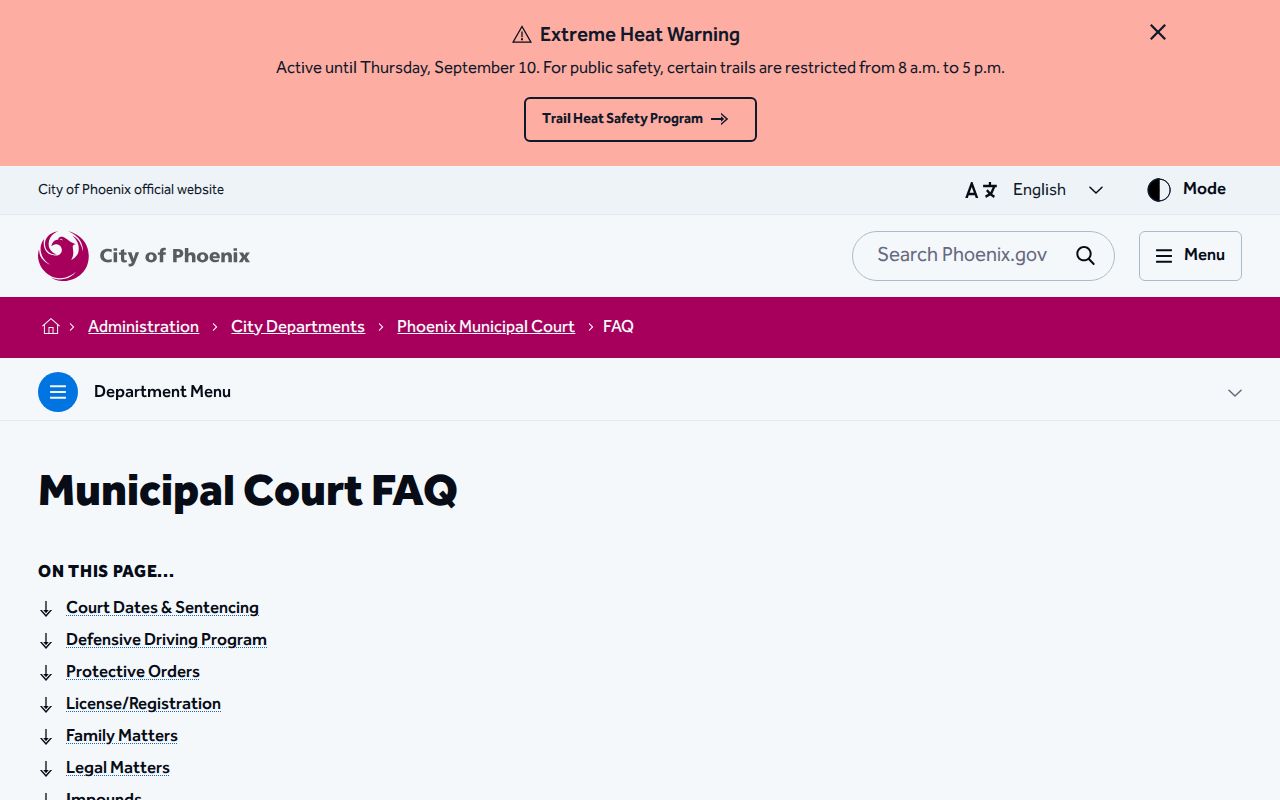
Phoenix Municipal Court, in Maricopa County, publishes a written request route for criminal and traffic warrant relief. Send it by email or mail. The request should identify the defendant, the case or complaint number, date of birth, contact information, the reason for the missed date or payment, the action requested, supporting copies, and a proposed affordable payment contract. Allow ten days for processing. The judge has choices. The court may cancel the warrant and approve a contract, cancel it and set a new date, or set a motion hearing. Full warrant payments run through online, mail, phone, in-person, and a 24-hour MCSO SIMS channel. Phone payment will not take a partial amount. That route belongs to Phoenix alone. Another Maricopa County court may do things differently. The official Phoenix instructions spell out the local steps and display no one's warrant record.
After a ruling or a payment, keep the court's written response. Ask Phoenix Municipal Court when the warrant status will update across Maricopa County.
Maricopa County Municipal Warrant Checks
Start with the city court's own search. Mesa offers eCourt and a warrant page. Chandler takes a case number or a name search, and Gilbert links “Find a Case.” Enter exact legal identity details privately. Glendale publishes a court-date interface and Phoenix lists court and records contacts, but in Maricopa County a city search result is only a lead until the clerk confirms the warrant is still active.
- Use the official city court portal with the case, complaint, or citation number when possible.
- Check AZDPS and the Arizona court index for leads, while accounting for local-ordinance exclusions and update delays.
- Call the municipal clerk through the city's official page. Ask for current warrant status and the required filing, appearance, or payment process.
- Use the city court records request or police records route for an existing document, and visit the clerk only under current instructions.
Mesa Walk-Ins for Maricopa County Municipal Warrants
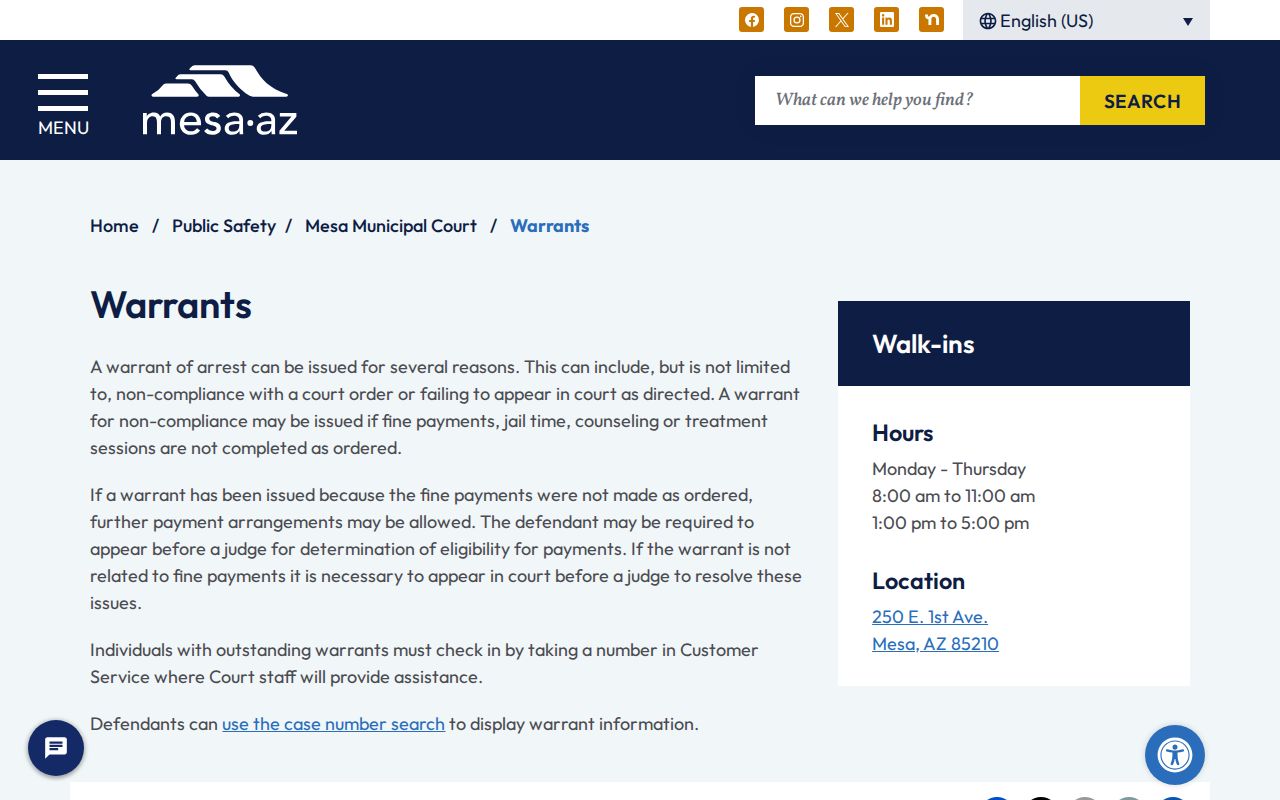
Mesa Municipal Court, in Maricopa County, tells anyone with an outstanding warrant to take a customer-service number first. Then check in at 250 E 1st Avenue. Its published walk-in hours run Monday through Thursday, from 8 to 11 a.m. and again from 1 to 5 p.m. Relief the court describes includes warrant quashing, jail reordering, counseling arrangements, and MVD suspension issues. The judge decides the exact outcome. Mesa eCourt is the official case-search entry, and the police Criminal Justice Information Division runs a separate public-record route. That channel can supply releasable records with redactions. It is not the city court's warrant decision. Mesa's official warrant page keeps that line clear.
Hours can shift. Call Mesa Municipal Court or check its current Maricopa County court page before traveling, since walk-in rules and hours may change.
Municipal Warrants: What They Show
Local interfaces differ. A Maricopa County municipal record can tie a case identifier to its court, charge, calendar event, result, and disposition. Chandler exposes case-number and name tabs, while Glendale's date interface shows date, time, case, defendant, attorney, description, courtroom, and status fields. None of these certify a current warrant.
| Case or complaint reference | A private identifier such as city court case number used to locate the file. |
|---|---|
| Charge or event | The ordinance, misdemeanor, traffic allegation, hearing, FTA, or compliance event. |
| Issuing court | The named city court and, where shown, the judicial division or courtroom. |
| Financial terms | Any fine, sanction, payment status, bond direction, or contract entry the public docket releases. |
| Disposition or status | An event label that must be read with later entries and verified with the clerk. |
Police Records Do Not Confirm Maricopa County Municipal Warrants
In Mesa and Gilbert, the police departments publish record-request routes. Chandler and Glendale name police contact paths too. Those channels help when a person needs an existing releasable report, but they cannot tell anyone whether a warrant is active, recalled, quashed, or served. The municipal court answers that. Court records follow Arizona Supreme Court Rule 123, while agency records sit under Arizona public-records law with its own limits. Sealed, confidential, and juvenile files may stay closed. Victim details, addresses, dates of birth, Social Security numbers, and criminal-history information can be redacted, and a records response in Maricopa County may also lag the live status question.
Key point: Use police records for existing police documents and the issuing municipal clerk for present warrant status and resolution instructions.
Maricopa County Municipal Warrant Routes Vary by City
In Maricopa County, Chandler Municipal Court offers a case-number tab and a name-search tab. The name search asks for a last name and a first name, the first name typed with just two letters. No date-of-birth field appears. Similar-name results need private verification with the clerk. Chandler also publishes a detailed records form. It covers requester identity, date of birth or case number, requested document types, delivery, commercial use, signature, and a CAPTCHA. Delivery choices include email, postal mail, or view-only. Processing can take up to 30 calendar days. Fees run $17 per case plus $0.50 per page for a noncommercial request. The commercial route costs $27 per case. A records request can obtain available documents. It cannot stand in for an urgent warrant confirmation. Too slow, and too limited. For criminal FTA, Chandler describes a written motion or a walk-in during published court hours. Call the court before relying on old hours or fees. Gilbert, another Maricopa County city, posts "Find a Case," "Pay Fine," forms, and electronic-motion links. Its sanction form tells a person who missed the court date to contact or appear immediately and lists 480-635-7800. Before that date, the form allows mail, fax, or a 24-hour drop box. A payment plan requires an appearance and adds a $20 time-payment fee. Gilbert Police uses a JustFOIA records route in this part of Maricopa County. Its stated limits on arrest information reinforce the gap between police documents and municipal court status across Maricopa County.
Glendale, also in Maricopa County, runs a date-search interface with fields for date, time, case, defendant, attorney, description, courtroom, and status. That is a calendar schema, not a warrant certification. The Glendale bond card lists court and payment contacts and warns that noncompliance may bring a warrant, default, suspension, and collection costs. Call 623-930-2400 before appearing. Use the payment line, 623-930-2427, only after confirming the case and court instructions. These differences explain why no generic Maricopa County city court assumption works. Identify the municipality and the exact court first. Then use that Maricopa County court's portal or clerk. Ask whether the case is criminal traffic, civil traffic, misdemeanor, ordinance, or another local matter. Ask what the latest docket event means, whether a warrant is active, and which judge or division can act. Keep written proof of each step. Recheck after the court's processing period.
A blank result in one Maricopa County system cannot clear a matter from another. The statewide index expressly omits local-ordinance charges and other protected categories. AZDPS says its warrant data may be incomplete or out of date. MCSO links a warrant lookup. It publishes no complete, documented field inventory. Treat each tool as a routing aid. Keep the city clerk at the center of any Maricopa County warrant check. For an in-person visit, bring only what the court requests, usually government identification and the case, complaint, or citation number. Ask in advance about security, check-in, motion filing, payment methods, and whether counsel should arrange the appearance. A courthouse counter and a jail intake facility serve different functions. Do not appear at a custody site unless the court or an attorney gives that instruction. After a quash motion, walk-in, hearing, payment, or bond, request a copy of the resulting record. The useful proof may be a filed motion, minute entry, judge's order, receipt, disposition, or MVD abstract. Ask when the local docket will update. Confirm anything sent to another system has processed. That final check keeps an intermediate step from looking like completed warrant relief. For a possible city warrant held outside these five Maricopa County municipalities, use the Arizona Judicial Branch court directory and the city's official site. Do not infer a procedure from Phoenix or Mesa. If arrest, probation, extradition, or a serious charge is involved, legal counsel can contact the proper clerk and arrange the safest authorized appearance or surrender route anywhere in Maricopa County.
Clearing a Municipal Court Warrant
Only the issuing city court in Maricopa County can say which step applies. Phoenix may accept a written quash request. Mesa publishes a walk-in route. Chandler describes a written motion or walk-in for criminal FTA, Gilbert says contact or appear promptly after a missed date, and Glendale lists court and bond-payment contacts. Payment alone is not proof of recall.
- Confirm the warrant, case, issuing judge, and the exact relief options with the city clerk.
- Follow the authorized route, which may be a written motion, walk-in, scheduled appearance, payment arrangement, bond, or attorney filing.
- Address the underlying case and any distinct MVD hold or suspension under the court's instructions.
- Keep the order, receipt, motion, minute entry, or abstract and recheck the court record after processing.
Warning: Never pay an urgent caller through gift card, cryptocurrency, QR code, or payment app. Verify every demand with the official court.